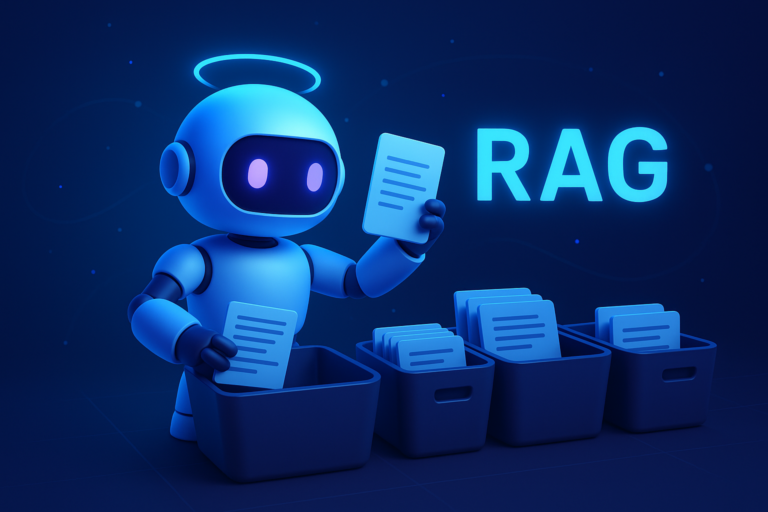
RAG · Knowledge Management
Harnessing Cutting-Edge RAG Technology for Next-Generation Knowledge Management
Book a strategy call
Key takeaways
- An end-to-end RAG system turns millions of scattered documents into instant, sourced answers — Docling ingestion, adaptive splitting, OpenAI embeddings, Qdrant hybrid search, CohereRerank, and an LLM answer step.
- Hybrid dense + sparse retrieval plus reranking surfaces the right passage, and a self-correcting quality loop catches hallucinations before they reach the user.
- Results for the enterprise client: 80% higher search accuracy, 70% faster retrieval, 40% productivity gain, and 30% lower operational cost.
Organizations today are overwhelmed by an ever-growing volume of unstructured documents, emails, and reports. Traditional keyword-based search and isolated data silos rarely deliver the accuracy and speed needed to derive meaningful insight — with real consequences for decision-making and operational efficiency.
One enterprise client, a multinational corporation, was grappling with exactly this. Critical information was spread across vast, disjointed sources, and retrieving actionable insight had become slow enough to hinder both day-to-day operations and strategic initiatives.
Rudder Analytics built an end-to-end Retrieval-Augmented Generation (RAG) system that combines advanced document ingestion, semantic embedding, and real-time retrieval — surfacing the most relevant information promptly, and reliably. What follows is the technical implementation, the architecture behind it, and the results it delivered.
The Challenge: Fragmented Data Impeding Decisions
The client had accumulated millions of heterogeneous documents over the years, which created three compounding pain points.
Time-consuming searches
Employees spent excessive time manually sifting through disparate systems to find what they needed.
Loss of context
Unstructured formats — PDFs, DOCX, HTML reports, Markdown guides — made it hard to preserve the nuanced context that effective decisions depend on.
Inefficient retrieval
Conventional search couldn't capture the semantic relationships needed to surface the most relevant information, degrading answer quality and slowing decisions.
The Solution: A Seven-Stage RAG System
The system combines production-grade components with sophisticated orchestration to deliver contextually accurate responses. The pipeline runs in seven stages.
Data ingestion with Docling
Docling ingests any format — PDF, DOCX, HTML, Markdown — without data loss, using optimized parsers and custom pre-processing hooks. Asynchronous batch processing with detailed error logging flags and re-processes malformed documents without stalling the pipeline.
Transformation & adaptive splitting
Each document is routed to a specialized splitter by type — recursive character splitting for long unstructured text, header-aware splitting for HTML and Markdown — with a sliding-window token overlap so context isn't lost at segment boundaries.
Semantic embedding generation
Each chunk is transformed into a high-dimensional embedding using OpenAI's text-embedding-3-large — a transformer model that captures semantic similarity, optimized for low-latency search, clustering, and classification.
Hybrid search & vector storage with Qdrant
Embeddings are indexed in Qdrant. Dense semantic search (cosine similarity) runs alongside sparse keyword search (TF-IDF / BM25), and a dynamic score-fusion algorithm adaptively weights both to return the most relevant results.
Document reranking with CohereRerank
Top candidates are re-scored by CohereRerank, a transformer reranker that weighs the full query context and document attributes to distinguish closely related passages — engineered for low-latency production use.
Response generation with GPT-4o
The reranked passages and the original query are fed to GPT-4o, which synthesizes a coherent, contextually grounded answer in real time — chosen for its balance of low latency and response quality.
Orchestration with Self-RAG LangGraph
The whole pipeline is coordinated by Self-RAG LangGraph, which ties preprocessing to real-time query handling — the layer covered in detail below.
Orchestration: Self-RAG LangGraph
At the core sits the Self-RAG LangGraph framework, modeled as a Directed Acyclic Graph (DAG) where each node is a processing task and runs only when its prerequisites are met.
One-time ingestion, then on-demand querying
Documents are uploaded and ingested once — parsed, enriched with metadata, and segmented into context-rich chunks ready for embedding. After that, every user query activates the retrieval nodes iteratively: hybrid retrieval, reranking, and answer generation run in real time so responses stay current and accurate.
Self-correcting quality control
Real-time dashboards monitor throughput, latency, and error rates per node, enabling automatic fault tolerance and load balancing. If output quality drops — for example, if hallucinations are detected — the graph triggers a query-refinement loop before the answer ever reaches the user.
The full pipeline is exposed as a RESTful API that integrates with the client's React frontend, delivering real-time responses to every query.
Impact & Results
Deploying the RAG system produced measurable gains across accuracy, speed, productivity, and cost.
Conclusion
By combining Docling ingestion, adaptive splitting, high-fidelity embeddings, and hybrid search — all orchestrated within Self-RAG LangGraph and paired with a responsive LLM and clean API integration — the system drastically improved the speed and accuracy of enterprise information retrieval. The measurable impact on speed, accuracy, productivity, and cost shows what a well-engineered RAG architecture can do for enterprise knowledge management.
Turn your document sprawl into instant answers
Rudder Analytics builds production RAG and knowledge systems that stay accurate, fast, and grounded in your own data.
Keep reading
Related Blogs
AI Agent for Loan & Mortgage Approval
A LangGraph agent that automates underwriting with a human-in-the-loop review step.
Read blog
AI Agent for SQL Queries & Visualization
A multi-agent framework that writes SQL and builds visualizations from plain-language questions.
Read blog
Transforming Financial Customer Support with AI
Conversational AI that resolves financial support queries with speed and accuracy.
Read blog
Knowledge Retrieval in Education: SMS-Based Q&A
An SMS-based Q&A system bringing AI knowledge retrieval to low-connectivity classrooms.
Read blog