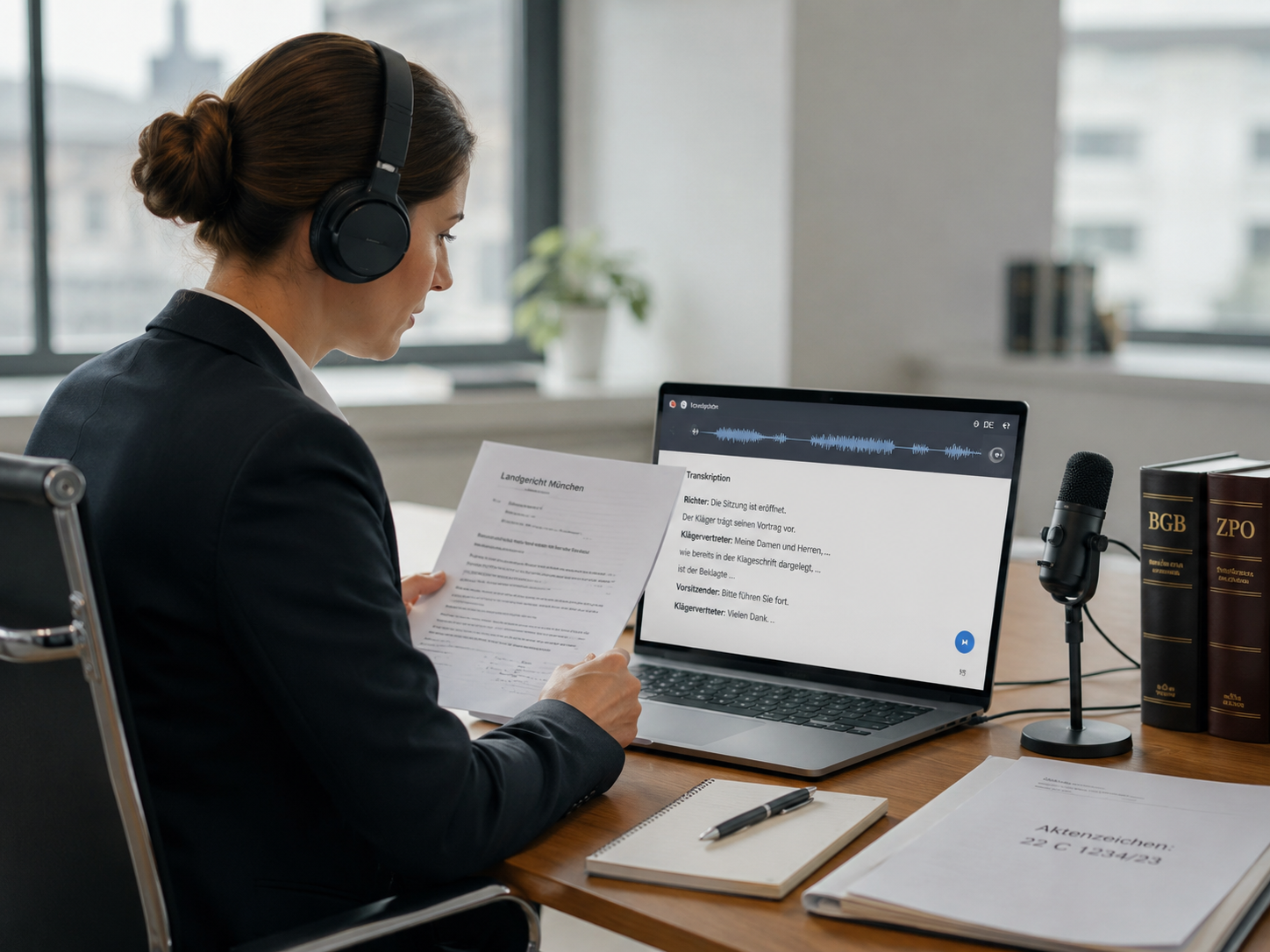
In the rapidly advancing digital era, the legal profession confronts unique challenges, particularly in ensuring transcription accuracy and clarity. At Rudder Analytics, we identified a pressing need within a distinguished German law firm, which was battling the constraints of conventional transcription methods. These challenges extended beyond mere efficiency, impacting the fundamental aspects of integrity and confidentiality in legal communications. Consequently, acknowledging the limitations of existing solutions, we embarked on a mission to develop an innovative, secure, and precise transcription system, specifically tailored to the nuanced demands of the legal domain.
Beyond Standard ASR Solutions
Our process commenced with a deep understanding of our client’s distinct requirements. Despite the sophistication of available Automatic Speech Recognition (ASR) technologies, they were unsuitable. They could not provide the essential data control and privacy required in legal contexts. This realization led us to the necessity of creating a custom-built ASR system, one that could be intricately tailored to meet the firm’s specific needs, thereby ensuring the absolute confidentiality of all transcription endeavors.
Quality Training Data: The Key to Precise Legal Transcriptions
The effectiveness of any ASR system is intrinsically linked to the caliber of its training data. We delved into the vast archives of the Tuda de and Mozilla Commonvoice datasets, extracting an extensive array of German audio samples. This diverse compilation of recordings covers various dialects and speech contexts. It provides the indispensable raw material needed to develop an acoustic model. A model, which is capable of accurately interpreting the specialized language of the legal sector.
Enhancing Data Quality: The Preprocessing Phase
Before initiating the training phase, our audio data underwent a comprehensive preprocessing phase. This vital step involved employing advanced techniques to enhance data quality, including sophisticated noise reduction, clarity improvement, and volume normalization. We utilized state-of-the-art algorithms for Mel-frequency Cepstral Coefficients (MFCC). These represent the short-term power spectrum of sound. Additionally, we employed Cepstral Mean and Variance Normalization (CMVN) to normalize speech features. Lastly, we used i-vector extraction to capture speaker and session variability. This ensured our model was trained on the highest quality audio features available.
Mastering the Acoustic Model: Capturing Speech Nuances
The heart of our ASR system was the acoustic model, meticulously crafted and trained using NVIDIA’s A10 GPU. We chose the Time Delay Neural Network (TDNN) architecture for its unparalleled ability to process the temporal variations in speech. TDNN, a type of deep neural network, excels in recognizing patterns over varying time scales, making it particularly effective for speech tasks. Through intensive training on our carefully curated dataset, we fine-tuned the model. It discerns the subtle intricacies of the German language used in legal settings. This ensures unmatched transcription accuracy.
Evaluating the Acoustic Model
An essential step in our implementation process involved thorough system testing and evaluation. We evaluated the model's performance using Word Error Rate (WER), a widely used metric in speech recognition. WER helped us gauge how frequently the model inaccurately predicted phonemes. WER is crucial for assessing Automatic Speech Recognition (ASR) systems, providing a measurable indicator of transcription accuracy. It is calculated by comparing the ASR system's output to a reference transcription, considering the number of substitutions, deletions, and insertions required to align the system's output with the reference.
Achieving Transcription Accuracy: Integrating Language Models and Decoding Graphs
We incorporated a sophisticated language model along with a comprehensive decoding graph. The language model, crucial for understanding the grammatical and syntactic structures of the German language, refined the system's word sequence predictions. Simultaneously, our decoding graph, a complex structure that evaluates potential word sequences against the audio input, analyzed these sequences, ensuring the final transcriptions were not only precise but also coherent.
During the decoding process, the sophisticated acoustic model would first map raw audio to a lattice of phoneme predictions based on its training. The language model could then refine and contextualize these into valid word sequence hypotheses, leveraging encoded rules about German linguistic patterns. Finally, the decoding graph would prune and rank these word hypotheses against the lexicon constraints to output the most statistically likely transcription.
Enhancing Legal Transcription Standards
The introduction of our custom German ASR system marked a significant milestone for our client. Achieving an impressive Word Error Rate (WER) of 3.2% under standard conditions and demonstrating resilience with a 5.2% WER in challenging acoustic situations. Our system established new benchmarks for transcription accuracy in the legal arena. Its proficiency in processing specialized legal vocabulary renders it an indispensable tool for our client.
Moreover, our system facilitated significant cost savings, reducing manual transcription expenses by up to 70% and substantially boosting staff morale. We remained steadfast in our commitment to data protection and privacy, ensuring our system adhered to the most stringent privacy regulations, achieving 100% compliance. The system's consistent performance across various accents, speaking styles, and audio quality levels cemented its critical role in our client's operational framework.
Charting the Future with Cutting-edge Legal Technology
Our German ASR system's success proves AI and machine learning can transform industries. This is especially true for the nuanced and sensitive legal industry. This project met our client's immediate transcription needs while leading the pathway for integrating advanced technological solutions into traditional practices. As we strive to advance the frontiers of AI and machine learning, our initiative stands as a guiding light. It demonstrates how cutting-edge technology can greatly improve professional efficiency, security, and adaptability. This heralds a new era in seamlessly integrating technology and law.
Speech AI built on your own calls and recordings
Rudder Analytics builds speech recognition, voice agents and audio analytics that run in production.
Keep reading
Related Blogs
A Deep Dive into Phoneme-Level Pronunciation Assessment
In the rapidly evolving digital education domain, our team at Rudder Analytics embarked on a pioneering project.
Read blog
Enhancing Digital Communication with Text-to-Speech Technologies
In the dynamic world of digital communication, messaging apps play a crucial role in connecting people globally.
Read blog
Streamlining Medical Transcription with Speaker Diarization
In the modern era of digital communication, the need for accurate and efficient transcription of conversations has…
Read blog
Voice-Controlled Amenities for Enhanced Hotel Guest Experience
In the hospitality sector, delivering exceptional guest experiences is a top priority.
Read blog