


Over the past years we have seen an exponential increase in the amount of data being generated. On an average, nearly 2.5 quintillion bytes of data was being generated every day in 2012. Extracting actionable insights from such prodigious amount of data can be a nearly impossible task at times.
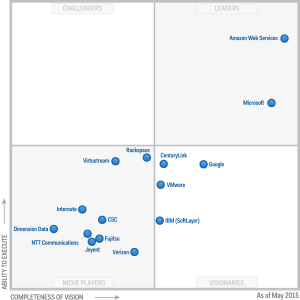
Amazon Web Services has been one of the pioneers in catering to the ever-changing data needs of enterprises with its highly scalable and pay-as-you-use services.
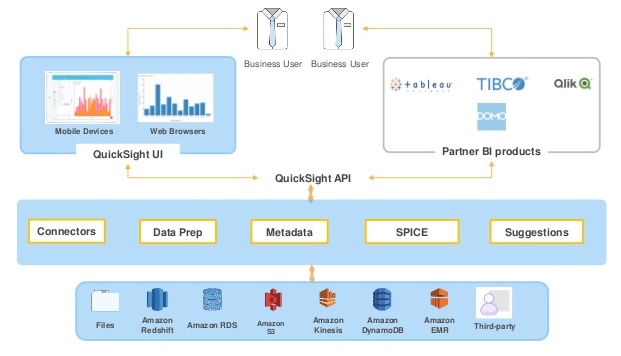
AWS senior vice-president, Andy Jassy recently unveiled QuickSight, a brand new service from AWS in Business Intelligence domain, during an annual re-invent conference held for developers. Some of its salient features are
- Extremely fast, cloud-powered, BI service for 1/10th the cost of traditional BI software.
- Fast Calculation with in-built SPICE (Super-fast, Parallel, In-memory Calculation Engine)
- Easily scalable with thousands of customers and terabytes of data.
- Provides SQL-like interface for other BI Tools to access data stored in SPICE.
Most of the organizations using traditional BI solutions (SAP Business Objects/Crystal Reports, IBM Cognos, Oracle BI etc.) invest in substantial resources to get their first visualization. Agile BI solutions (Tableau, Qliksense, Sisense, Domo etc.) have their own constraints in terms of processing and customization capability, which limit their potential use.
Bearing in mind all these aspects, we need to ask, “Can Amazon QuickSight really kill the old guard BI services?” Let us take a look at some of the many crucial characteristics that we can consider to compare Amazon QuickSight with the market leader in BI services i.e., Tableau.
Price
Amazon QuickSight has come up with an extremely competitive pricing structure (90% less as compared to other BI products). Its standard edition is priced at $9 per month per user and the enterprise edition is priced at as low as $18 per month per user (one year contractual basis).
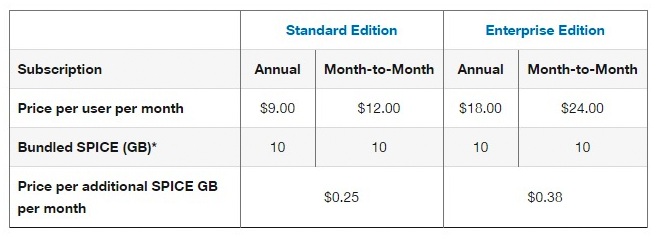
Tableau on the other hand has its cloud-based service (Tableau Online) starting at $500 per user per year. This gives QuickSight a huge edge over other competitors, especially while catering to small to medium enterprises, which are sensitive on budget.
Data Processing
One of the major features of Amazon QuickSight is SPICE- a Super-fast, Parallel, In-memory Calculation Engine. Based on the technique of columnar storage coupled with in-memory technologies, SPICE helps in running queries at a lightning rate producing results in a few milliseconds with following salient features:
- 2 to 4x compression columnar data
- Compiled queries with machine code generation
- Rich calculations and SQL-like syntax
Tableau’s Data Engine is an in memory analytics, high-performing database on one’s PC. It uses memory mapped I/O, i.e. the data is loaded in disks after it is imported. This results in low usage of RAM which eventually provides the desired performance.
Target Group
Both Amazon and Tableau, have a significant customer base ranging from small scale organizations to some of the top firms in the world. Nevertheless, AWS has been a promising player in providing customer satisfaction, as a result of which most of the organizations tend to use AWS for storing massive data. It makes sense here to say that Amazon will target its AWS users as potential customers for QuickSight. Many organizations are shifting their base from on-premise to AWS Cloud for several reasons. On the contrary, some enterprises still prefer to store their critical datasets on their local premise for legal and security reasons.
Ease of Use
Amazon posits QuickSight as a self-discovery tool which does not require people to have in-depth knowledge about data visualization. Tableau on the other hand requires certain level of expertise.
Features
Finding the right visualization for data is extremely important. QuickSight’s Autograph feature automatically predicts the best visual for your data to be displayed. Likewise, Tableau provides us with a “Show Me” which detects data based on data types, cardinality etc.
Limitations
QuickSight is most appropriate for data that is stored in AWS’s cloud and also more importantly the data that can be put onboard SPICE. As quoted by Ashley Jaschke (Director, Product Management, Tableau) QuickSight will be suitable for lightweight visualizations. Many companies still keep their data outside of AWS’s cloud. Since, Tableau has a provision for ingesting data from multiple sources it has the ability to provide much deeper and significant insights.
Outlook
QuickSight is currently available only as a preview version and it would be too early to decide as to whether QuickSight will dominate the BI services market, but it is surely poised to make a heavy impact.
Reporting every team can trust
Rudder Analytics builds the data foundation and dashboards that keep every team on the same numbers.
Keep reading
Related Blogs

Two Way Synchronization between Google Spreadsheet and AWS RDS using Google Apps Script
Google Spreadsheet can be a very nifty tool to satisfy dynamic data storage needs for any small to medium data…
Read blogFeatured on CNBC: IT Services Firms in India
Rudder Analytics on Clutch’s 2016 list of top IT services firms in India, carried by CNBC.
Read blogFeatured on the Power BI Data Stories Gallery
Ketan Deshpande’s data story, selected for the Microsoft Power BI Data Stories Gallery.
Read blogRanked Highly in Top Indian IT Services
A place in Clutch’s India IT Services Leaders Matrix, earned on client reviews.
Read blog