Project Description
Case Studies / AI & ML
AI & ML
Seamless Speaker Diarization System for Effective Conversation Transcription
Our healthcare client, a leader in surgical services, sought to optimize operating room transcription.
Book a strategy call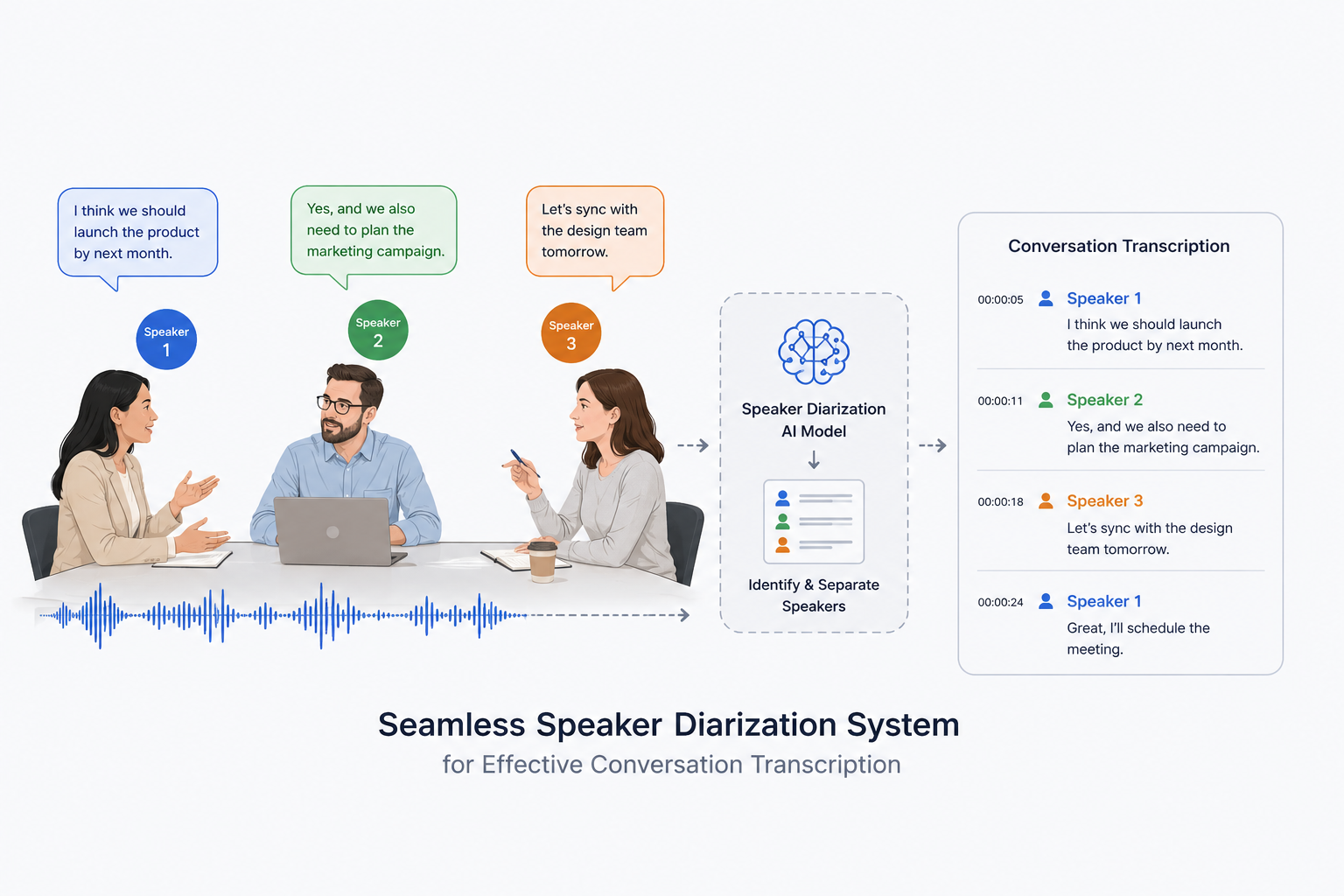
The Client
Client Overview
Our healthcare client, a leader in surgical services, sought to optimize operating room transcription. Embracing advanced speaker diarization, they aimed to enhance transcription accuracy during surgical procedures. The goal was to streamline post-operative analysis and improve medical documentation, ultimately elevating the quality of patient care through precise and reliable records.
01
Challenges
To build a system capable of performing speaker diarization for a given audio file.
The output should provide speaker-specific information about each speaker's start and end time.
Provide the duration for each speaker sequentially as per the occurrence in the given audio.
Ensuring the diarization system adapts to changing acoustic conditions, handling unexpected variations, and maintaining accuracy in dynamic environments.
02
Approach
Technical implementation
- We used Kaldi, an open-source Automatic Speech Recognition toolkit with the capability of training the models as required.
- Trained a TDNN-based x-vector model on common speech corpora using the ‘callhome’ recipe.
- Applied segmentation to capture key speech patterns and transitions between speakers, by dividing the audio recording into overlapping or non-overlapping segments.
- Extracted MFCC features from the segments to define the unique speech characteristics of different speakers.
- Mapped variable-length audio signals to fixed-length x-vector embeddings, encasing essential speaker-related information.
- Calculated similarity using a derived metric based on acoustic features, assessing resemblance between segment pairs.
- Employed clustering algorithms to categorize segments with similar acoustic traits, identifying potential speakers.
- Applied an iterative refinement process until speaker-homogeneous regions were obtained.
- Enhanced speaker diarization accuracy through iterative refinement of the model, using insights from preceding iterations.
03
Impact
Achieved a low Diarization Error Rate (DER) of 4.3%, accurately identifying speakers.
Streamlined post-operative analysis processes, resulting in a 40% reduction in the time required for reviewing and analyzing surgical transcripts.
Integrated speaker diarization seamlessly into Electronic Health Record (EHR) systems, leading to a 30% reduction in data entry errors and ensuring accurate and synchronized medical records.
Want results like these from your own data?
Talk to a specialistSee how you could get similar results
Rudder Analytics builds data and AI systems that ship — and stay tied to accuracy, cost, and customer experience.